
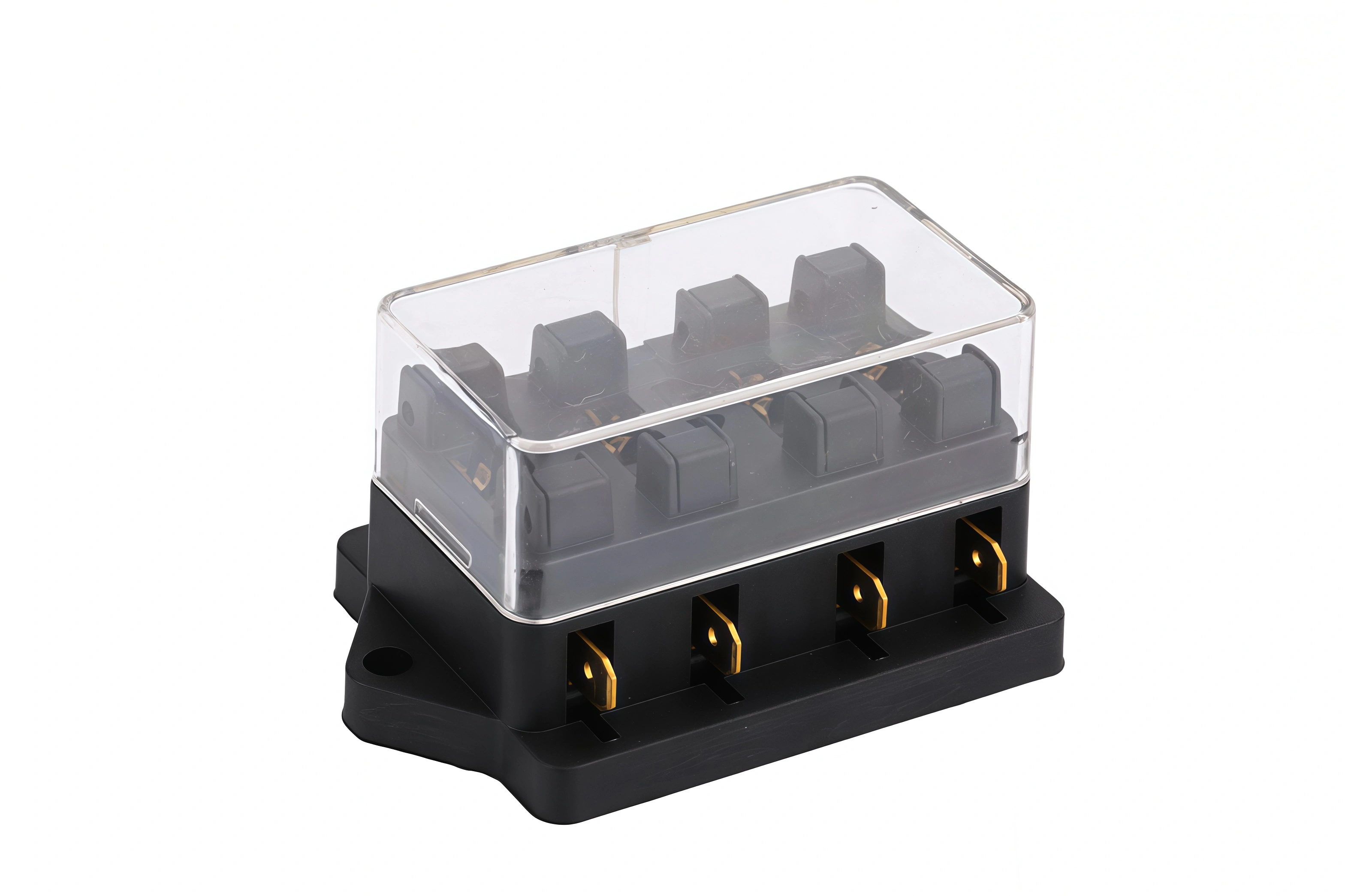
In a vehicle or any mobile equipment, a blade fuse holder is subject to continuous mechanical input for its entire service life. Engine vibration, road input, and harness movement all arrive at a contact that depends on spring force to do its job. It is not surprising that these assemblies loosen; what is surprising is how often the resulting faults get blamed on the device instead of the contact. This article covers what vibration does to a spring contact, why the damage is chemical as well as mechanical, and what actually keeps the assembly tight.
What Vibration Does to a Contact
A blade contact works by clamping two metal faces together hard enough that the interface resistance stays low. That clamping force is the entire design. Vibration attacks it in three ways. First, it produces relative movement. Even microscopic movement between the blade and the terminal is enough to disrupt the contact interface, and no mechanical joint is perfectly rigid under sustained input. Second, it works the spring metal. Cyclic stress on a formed contact causes it to take a permanent set over time, so the force it applies gradually falls. This happens even without visible damage. Third, it transmits load through the harness. If the cable is unsupported, its mass moves relative to the holder and the terminal ends up carrying that movement as a bending load, which accelerates everything else. The end state is a contact that still looks correct, still holds the device, and has significantly less clamping force than when it was new.
Fretting Corrosion Explained
The most damaging consequence of vibration is often chemical rather than mechanical, and it has a name: fretting corrosion. The mechanism runs like this. Small-amplitude movement rubs the contact surfaces together. That rubbing removes the protective plating and exposes fresh metal. Fresh metal oxidises almost immediately. The oxide is hard, abrasive, and electrically insulating, so it both raises resistance and increases the wear rate. The debris stays trapped in the contact, and the cycle continues. Fretting produces a characteristic appearance: dark, powdery debris at the contact, sometimes described as a black or brown smudge. It also produces a distinctive failure signature — intermittent operation that seems to come and go, because the debris layer is not stable. A bump in the road can momentarily restore contact, which makes diagnosis genuinely frustrating. This is why a device can be secure one moment and open the next, with no overcurrent anywhere in the circuit.
Retention Force Is the Design Variable
Since clamping force is what fails, clamping force is what to specify. Retention force is not usually printed on a datasheet, but it is a real design parameter, and it is where holder quality shows. A holder with well-designed contact geometry and correctly specified spring material will hold its force through years of thermal and vibrational cycling. One that is not will start high and fall away. When selecting, consider:
- Whether the holder and the device are from the same manufacturer and verified as a set
- Contact material and plating appropriate to the environment and the current
- Whether the holder has positive retention features — a latch, a locking clip, or a shroud — rather than friction alone
- Whether the design has been qualified for automotive or mobile vibration duty
- The insertion and withdrawal force when new, so you have a baseline to compare against later
Checking insertion force at every service interval is the single most useful maintenance action. A device that slides in more easily than it did last time is evidence of tension loss.
Harness Support Does More Than the Holder
Most vibration failures are harness problems presenting as holder problems. A length of cable with mass at the end of it, unsupported, becomes a lever. Every input from the vehicle is amplified at the holder. Support the harness and the holder sees very little. Practical measures:
- Secure the harness at regular intervals, with the first fixing close to the holder
- Provide a service loop so the conductor is not under tension and can be re-terminated once
- Avoid routing the harness so that it pulls across the holder at an angle
- Keep the holder away from direct engine mounting points and from structures known to resonate
- Use strain relief at the point where the harness enters any enclosure
These cost nothing at design stage and are almost impossible to retrofit properly once the harness is built.
Mounting Location and Orientation
Where the holder sits matters as much as how it is made. Prefer locations on the vehicle body or a stable bracket over locations on the engine or on a bracket attached to a vibrating assembly. Orientation is worth thinking about too: a holder mounted so that the device's weight is carried by the contact, rather than by the body, adds a constant load to the spring. Accessibility also counts for more than convenience. A holder that is buried behind trim gets inspected rarely, and a vibration problem in an inaccessible holder will be found only when it fails.
Inspection and Verification
Build these into the maintenance schedule:
- Check insertion and withdrawal force at every service, and compare with a known good position
- Look for fretting debris at the contacts — dark powder is a finding, not dirt
- Look for discolouration of the holder body, which indicates heating from a degraded contact
- Check harness fixings and strain relief, not just the holder itself
- Replace any holder whose retention has fallen, rather than trying to restore grip by bending the terminal
That last point deserves emphasis. Bending a terminal to restore grip is a temporary measure that usually makes the contact geometry worse and accelerates the failure.
Summary
Vibration loosens contacts mechanically and destroys them chemically through fretting. The defences are a holder designed and qualified for mobile duty with adequate retention force, a harness that is properly supported so it does not load the contact, a mounting location away from the worst input, and periodic checks of insertion force and contact condition.
About Our Vibration Rated Holders
GFEFUSE is the brand of Dongguan Gongfu Electronics Co., Ltd., an electronic protection device manufacturer established in Dongguan, Guangdong in 2013. Our integrated development, production, and sales team operates five advanced production lines with thirteen R&D engineers, and our products are exported to customers overseas. Our automotive fuse holder selection is engineered for defined retention force and is specified together with our blade fuse range so that contact geometry and grip are verified as a set. For multi-circuit assemblies we supply modular automotive fuse holder configurations, and harness installations are served by our wiring harness fuse holder range, which addresses strain relief directly. Products carry UL, cULus, TUV, CE, and CQC certification and comply with RoHS and REACH directives, serving automotive electronics, new energy, power equipment, communication systems, and consumer electronics.
Conclusion
A blade fuse holder in a vibrating application is a mechanical component as much as an electrical one. Hold the clamping force up, keep the harness from loading the contact, mount it somewhere sensible, and check retention at every service. Those four things determine whether the assembly lasts the life of the vehicle or becomes an intermittent fault that nobody can reproduce.
Tell us your current rating, mounting location, harness configuration, and vibration environment. We will confirm the right holder and retention features for your application.
Frequently Asked Questions
Answers on keeping blade contacts secure in vibrating applications.
Why does a blade fuse holder loosen under vibration?
Because vibration causes microscopic relative movement at the contact and cyclically stresses the spring terminal, which gradually takes a permanent set. Clamping force falls, contact resistance rises, and heat follows.
What is fretting corrosion in a fuse holder?
Wear caused by small-amplitude movement between contact surfaces. It removes plating, exposes fresh metal, and that metal oxidises immediately. The oxide is insulating and abrasive, so it both raises resistance and accelerates wear, producing intermittent faults.
How can I tell if a holder has lost retention?
Compare insertion and withdrawal force against a known good position. A device that slides in easily, or that wiggles after insertion, indicates lost tension. Dark powdery debris at the contact indicates fretting.
Should I bend the terminal to restore grip?
No. It distorts the contact geometry and usually accelerates the failure. Replace the holder, and address the cause — usually harness support or an unsuitable mounting location.
Does harness support really matter that much?
Yes, more than most people expect. An unsupported cable acts as a lever that transmits vehicle input directly into the contact. Fixing the harness close to the holder removes most of the load. A simple measurement confirms it: compare vibration at the holder body with the harness supported and unsupported, and the difference is usually larger than the difference between two holders of different quality. Good harness support also reduces the stress on the cable itself, extending conductor life and keeping the termination cool throughout the vehicle's service life, and that is a quiet benefit that pays back every year.